History of the Tugu Church in Jakarta and the Mardijkers
By Dalo · 5 min read
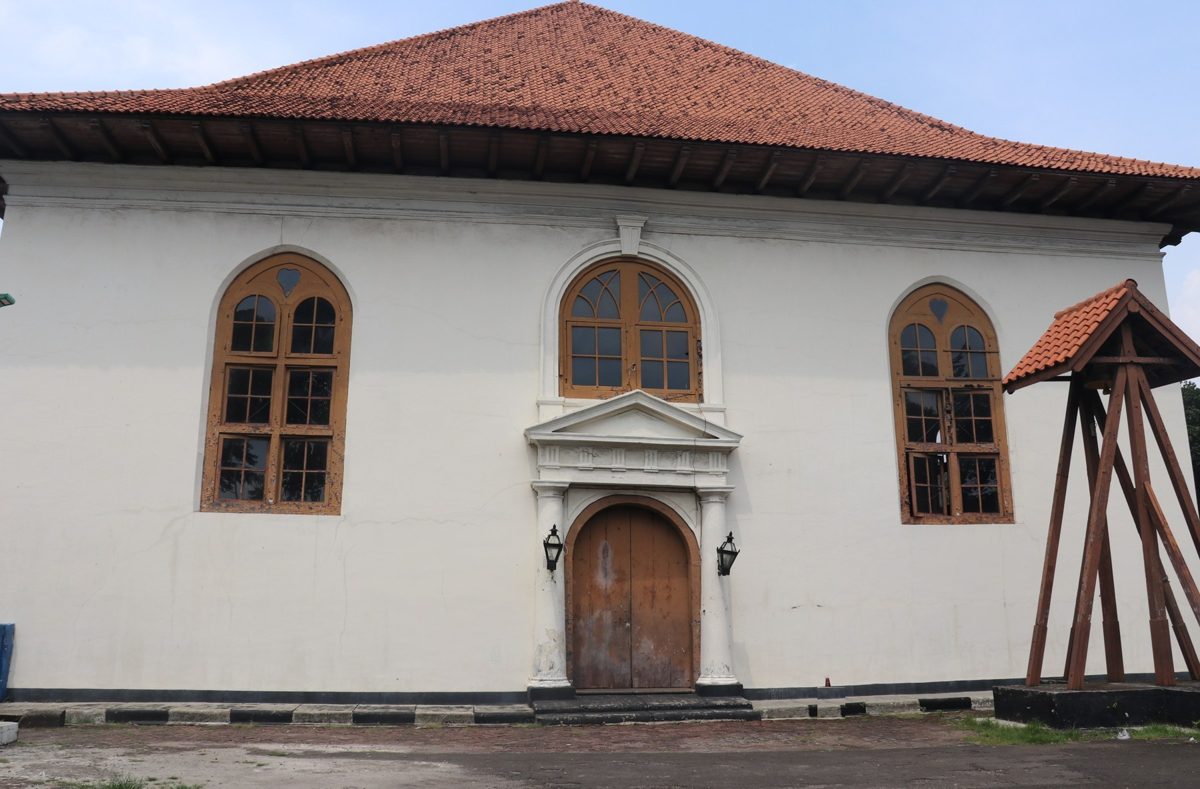
The Tugu Church is the old church building of the GPIB Tugu congregation, which has its roots in the land of Tugu, east of Batavia. A Christian congregation at Tugu appears in the records of the Batavia government as early as 1676, when 40 to 50 Christian households there asked for a teacher. The building that stands today, according to its heritage inscription, was built in 1744-1747 by Justinus Vink to replace a church destroyed in 1740.
That is the short answer. Behind the inscription lies a longer story about free people who settled east of Batavia, and about several things long taken as certain that may not be.
What was Tugu like in the seventeenth century?
In the VOC period, Tugu lay in the area outside the city of Batavia, to the east, among rivers, swamps, and gardens, near Marunda and Cilincing. In the seventeenth century this area was being opened up and guarded. The Company built a small fort at the mouth of the Marunda River in 1659, because many of the city's inhabitants went to that river for timber, bamboo, and fish.
The Tugu church building has white walls and a tiled roof, with a porch in front of the door, a bell between two posts in the yard, and a cemetery behind. Its heritage inscription was installed by the Jakarta Provincial Culture Office (Dinas Kebudayaan DKI Jakarta) in 2021.
Who were the Mardijkers?
The word Mardijker is rooted in the Sanskrit maharddhika, which originally meant a great or noble person, and in the Indonesian archipelago shifted to mean a person who was free or freed. In seventeenth-century Batavia, the word referred to Asian Christians who were no longer enslaved.
According to historians, many of them were formerly enslaved people brought from the Indian subcontinent. They were freed, baptized, and spoke Portuguese Creole among themselves. The group grew quickly in Batavia, and some of them later owned land and gardens at Tugu.
Was Tugu really a Portuguese village?
Many writings call Tugu a Portuguese village, and the tie with Portugal remains alive in the memory of Tugu's descendants to this day. The book Orang Merdeka di Tanah Tugu treats that memory as part of the community's history, not as an error to be corrected.
Yet when the oldest documents about Tugu are read one by one, an interesting question arises: what names were used for the inhabitants of Tugu in the seventeenth and eighteenth centuries, and since when has the word "Portuguese" been read as their origin? The answer is not as simple as is often written. The book traces the journey of that label from archive to archive, and this problem is the subject of Chapter 1, which can be read free.
The same applies to the year 1661, often given as the beginning of Kampung Tugu, and to the various origin stories in circulation: prisoners from Malacca, people from Goa, even the tale of soldiers whose ship was wrecked in the bay of Batavia. The book tests each of these stories against contemporary sources that can be checked.
Why was a church destroyed in 1740?
The inscription describes the present building as the replacement for a church destroyed in 1740. That year was a year of great violence in Batavia: fighting between VOC troops and the Chinese outside the city, and then the killing of thousands of Chinese inside the city. The Tugu church was also a casualty in those months.
So what kind of church was destroyed, when was it built, and who witnessed its destruction? Tradition gives one year for the first church at Tugu, while the archives of the Batavia government give a different sequence of events. The book reads those reports carefully, including the testimony of the people of Tugu themselves, and presents them as the wording of the sources, not as an accusation against the Chinese as a group. The story is in Chapter 9, which can also be read free.
Vink's church and two languages
Justinus Vink was a landdrost, the government official for the area outside the city of Batavia. The inscription names him as the builder of the replacement church, and the archives record that worship in the Tugu church was set to be held in Malay and in Portuguese.
One question is still open: is the building that stands today really Vink's church? The archives read for the book cannot yet confirm it.
From Portuguese to Tugu kroncong
The Portuguese language at Tugu lasted a long time, but it changed and mixed with Malay. Kroncong is now Tugu's mark of identity, and according to the congregation's leaders, speaking to the author, Tugu kroncong groups take turns accompanying Sunday worship once or twice a month.
When kroncong began to be played at Tugu cannot yet be established. The book gathers the oldest musical records that can be found, and includes the testimony of present-day Tugu residents about kroncong, the new year traditions, and the way they remember their history.
What is not yet known
- No contemporary document granting land at Tugu in 1661 has yet been found.
- Who the first inhabitants of Tugu were and where they came from is not stated in the oldest documents read.
- Whose houses also burned in 1740, and whether there were deaths, is not yet known.
- Whether the present building is Vink's church cannot yet be confirmed from the archives.
Questions and answers
When was the Tugu Church built?
According to the heritage inscription, the present building was built in 1744-1747 by Justinus Vink, to replace a church destroyed in 1740.
Who was Justinus Vink?
Justinus Vink was a landdrost, the VOC government official for the area outside the city of Batavia. The heritage inscription names him as the builder of the present Tugu church.
What does Mardijker mean?
Mardijker means a free person; the word is rooted in the Sanskrit maharddhika. In seventeenth-century Batavia the term was used for Asian Christians who were no longer enslaved.
Is Tugu kroncong still played in the church?
Yes. According to the congregation's leaders, Tugu kroncong groups take turns accompanying Sunday worship once or twice a month.
Read the full story
The book Orang Merdeka di Tanah Tugu by Dalo follows the free people of Tugu through the VOC archives in Jakarta and The Hague, complete with footnotes and the Register of Gaps, a list of questions not yet answered. Why the label "Portuguese village" needs to be re-examined is in Chapter 1 The Problem of the "Portuguese Village", and the story of the church destroyed in 1740 is in Chapter 9 A New Church and Fire, 1737-1744. Both, together with the Prologue Stone, Name, and Song, can be read free. The full book (in Indonesian) is open to Motivasi Kasih subscribers.
This article is summarized from the book Orang Merdeka di Tanah Tugu; the full source notes are in the book.