A New Church and Fire, 1737–1744
On Friday, 29 November 1737, the Governor-General and the Council of the Indies met in Batavia Castle and settled a group of church matters in a single entry. In the middle of it is a request that a minister, Ds. Dirk Joan van der Tijd, who served the Portuguese-speaking congregation in the city, be permitted to go to Tugu to dedicate the new church there. The Council granted it on one condition: the minister might set out only after the bad season had passed.1
The church at Tugu did not last long. Three years later, on 13 October 1740, the Castle diary recorded news that the church at Tugu had been burned.2 This chapter follows that church from permission to fire, and on to the moment, four years later, when the government permitted a church to replace it.
The request of 1735
Two and a half years before that permission, the Tugu congregation had already been the subject of a request. Through an extract of its decision of 13 June 1735, the church council (kerkeraad) of Batavia pointed out to the government the need to rebuild a place of worship at Tugu, ingevolge van het versoek, dat daarom door deselve gedaan is, in accordance with the request made for that purpose. The phrase may refer either to the council's own request or to a request from the Tugu congregation. On 17 June 1735 the Council decided that a school- en gebeden huys, a school and prayer house, would again be built at Tugu, “tot oeffening van den Godsdienst”, for the practice of worship, and that a teacher (leermeester) would again be placed there.3
The word “again” appears twice in that resolution: weder opbouw, rebuilding, and wederom, once more. A school and prayer house had once stood at Tugu, and there had once been a teacher there. Before 1735 neither existed any longer; the resolution does not say why.
The request came with figures. At Tugu, the resolution says, there were 19 communicant members (ledematen), 134 baptized adults, 64 baptized children under fourteen, and 17 unbaptized people.4 If the four categories are added together, the result is 234 people. The figures describe a congregation that was mostly baptized but had not yet made public profession of faith: only one in twelve was recorded as a communicant member, entitled to take part in Holy Communion. More than a quarter were children. The resolution names the duties of the teacher who was to be placed there: teaching the children and conducting worship.
Two years later a government source already speaks of de nieuwe kerke, the new church, at Tugu. The 1737 resolution does not explain whether that “church” was the school and prayer house decided on in 1735, now given a grander name (G-005). A letter from the Governor-General and the Council of the Indies to the Netherlands, written after June 1736 and probably at the end of that year, gives a clue. Among the works that had been contracted out and completed by their contractors, the letter names de kerk en schoolmeesters woning op Toegoe, the church and the schoolmaster's house at Toegoe, in accordance with the decisions of 19 August and 9 December 1735 and of 11 May and 19 June 1736.5 The school and prayer house decided on in June 1735 and the new church mentioned in 1737 were therefore very probably a single building project, although the form of the building remains unknown. According to the Company's balance sheet at the end of 1767, the Council of the Indies decided on 8 October 1735 to buy a plot of land at Toegoe, two and a half hours east of the city, from the widow of a mistiesburger, Willem Gabriëls; the price was paid according to a deed of sale dated 13 January 1736. What the land was used for is not stated, but the same balance sheet also records the cost of acquiring a prayer house and a teacher's house at Toegoe.6
The first decision in the letter's list takes us to mid-August 1735. On the 15th of that month the Council gave a task to two men: Nicolaas Crul, commissioner for native affairs (gecommitteerde tot en over de saaken van den inlander), and George Frederik Haseman, head of the fabriek, the Company's building works. Both were ordered to see the place for themselves (oculaire inspectie) and to consider the best way of building at Tugu a prayer house for the practice of worship and a house for the teacher. On Friday, 19 August 1735, four days after that assignment, their report was already before the Council, together with een plan of afteekening, a plan or drawing. The Council decided that the work should proceed according to their directions, and ordered the two men to put it out to tender (aanbesteden).7
So the Tugu prayer house followed the path of the Company's public works. The site was inspected, a plan was drawn, the work was tendered, and then a contractor carried it out. The matter was handled by the commissioner for native affairs, not by the church council; in the Company's administration, the Tugu congregation fell under the affairs of the native Christian population. Who drew the plan, what it looked like, what material the building was made of, and who the contractor was are not stated, either in that decision or in the letter to the Netherlands. The drawing has not been found (G-005).
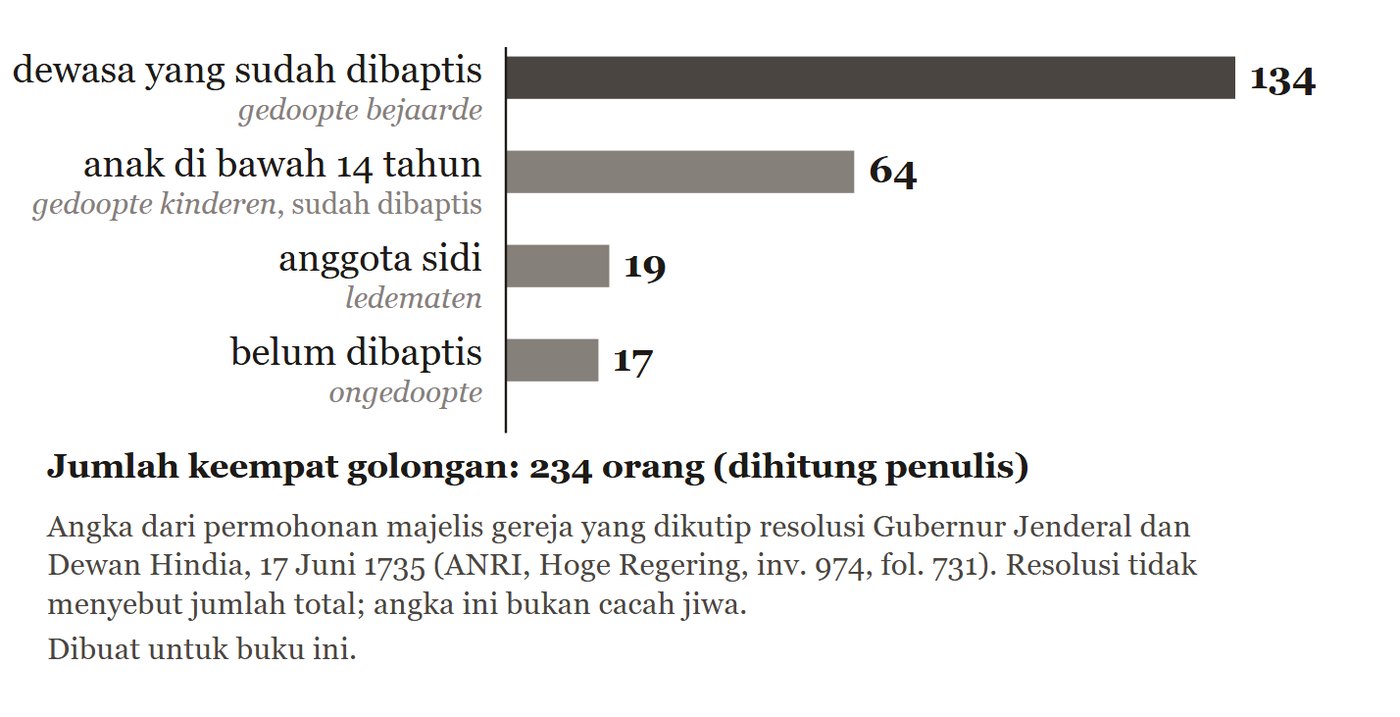
Illustration 6. The Toegoe congregation according to the church council's request as quoted in the resolution of 17 June 1735. The total of 234 was calculated by the author; it is not a census figure. Made for this book.
A new church, waiting for the season
The part of the entry of 29 November 1737 that concerns Tugu is a single long sentence; who submitted the request appears in the opening part of the entry, which has not yet been transcribed. The sentence reads:
[...] dat de predikant in de portugese gemeente Dirk Joan Van der Tijd voor zijn particulier mogte werden gepermitteert, na verloop van het quade saijsen[?] de nieuwe kerke op Toegoe voorm: te mogen gaan inwijen; Zoo is naar overweging van het een en ander goedgevonden, in de versoeken [...] haar Edele te consenteeren [...]
[...] that the minister of the Portuguese congregation, Dirk Joan van der Tijd, might for his own part be permitted, after the bad season has passed, to go and dedicate the aforementioned new church at Toegoe; it was therefore resolved, after weighing all of this, to grant Their Honours [the] requests [...].8
Written at the end of November, the “bad season” was very probably the rainy season.9 Permission was given, but the journey was postponed until that season was over. The new church at Tugu, which seems already to have been standing, waited for its minister. The Castle itself was changing leaders: three days after that permission, on 2 December 1737, the death of Governor-General Abraham Patras was announced and his successor, Adriaan Valckenier, was presented.10
The minister appointed was not a minister of the Dutch or the Malay congregation, but of the Portuguese congregation. Tugu seems to have been regarded as part of the Portuguese-language ministry, which in Batavia at that time also had churches inside and outside the city walls.11 The minister may have come to the Portuguese congregation from far away. In August 1723 a minister named Dirck Johan van der Tijd sailed from Batavia to the West Coast of Sumatra. In 1730 another minister with the same surname, Bernardus van der Tijd, was sent to Coromandel to relieve Dirk Johan van der Tijd, minister of the congregation at Nagapatnam, on the Indian coast.12 If the records of 1723, 1730, and 1737 refer to the same man, the minister permitted to dedicate the Tugu church had already served in Sumatra and on the Indian coast before serving the Portuguese congregation of Batavia.
When he left for Tugu is not recorded in the government registers that were examined.13 The answer is kept instead far from Batavia, in The Hague, in a copy of the Batavia church council's annual report to the Heeren XVII. Under the heading Toegoe buyten Batavia, the report dated 26 January 1739 records that a new church had been built there, and that Dirk Jan van der Tyt dedicated it on 12 June 1738. His sermon was taken from Psalm 65 verse 5, and afterwards he administered Holy Communion with 30 communicant members; 2 adults and 15 children were also recorded as baptized.14 June is the dry season: the dedication took place after the bad season mentioned in the permission had passed.
October 1740
In early October 1740 the government diary in Batavia was full of fighting between VOC troops and the Chinese outside the city, and then of the killing of the Chinese inside the city. Those events, in which thousands of Chinese inside the city were killed within a week, are not retold here.15 We follow only the marginal notes of the Castle diary, the Dagh-Register, in the days before the news from Tugu, because that news would arrive through the same notes.16
On 7 October 1740 two government commissioners returned from Tanah Abang bearing a letter from a leader of the Chinese outside the city, and troops were sent to Tanah Abang, Tangerang, and Angke. On 8 October the diary recorded fighting outside the city: the troops sent to Tangerang the day before were driven back by the Chinese, a post was overrun and its post-holder and four of his soldiers were killed, and from Tanah Abang the commissioner Van Imhoff reported that the Chinese there had been attacked and driven off, with many cut down.
Inside the city, according to the same notes, the Chinese were forbidden to walk about in groups and were ordered to stay indoors from half past six in the evening, the house of the Chinese Kapitan was searched, and patrols were formed from a sergeant, eighteen European soldiers, and eenige christen inlanders, some Christian inlanders, a term that in sources of that time probably referred to Asian Christians who were not European.17
The marginal note for 9 October records violence in the east: the crew of the guard post at Groote Maronde, Great Marunda, not far from Tugu, was driven out door de Chinesen, by the Chinese, and a burgher (burger) living there, Hendrik de Groot, was killed. A detachment sent to Bekasi, according to the diary, was killed to the last man.18
On the same day, inside the city, the marginal notes mention a fire in a Chinese house and shots fired from Chinese houses on the Groene Gracht. Then the diary records: Een generale massacre soo als binnen en buyten dese stad door het gemeen begonnen, a general massacre, begun by the common people both inside and outside the city. The order to stop it, the next note says, had no success.19 For that night the diary records a great fire and many Chinese who were burned, shot dead, or took their own lives.20 The next day, 10 October: people did their best everywhere to put out the fire, maer het capotteeren der Chinesen kon niet gestuyt werden, but the killing of the Chinese could not be stopped.21
Among these notes there is one line about the church of the Portuguese congregation in the city. On 9 October a squad was stationed bij de Portugeese kerk op gemelte Jonkersgragt, at the Portuguese church on the Jonkersgracht, and three cannon were placed there.22 That day the church of the city's Portuguese congregation became a post for troops.
News from Tugu
The news from Tugu was entered in the Castle diary four days later. On Thursday, 13 October 1740, the entry was given the marginal heading Quaede huyshouding der Chinesen tot Toegoe &ca., misdeeds of the Chinese at Toegoe, and so on. The core of the report:
[...] dat die van de Chineese natie op den 9en courant de kerk aldaer met de meeste van hunne huysen in den brand gestoken hadden [...]
[...] that those of the Chinese nation had, on the 9th of this month, set fire to the church there together with most of their houses [...].23
The 9th of October is the same day as the expulsion of the post at Great Marunda and the beginning of the massacre in the city. The report was written in the voice of the government, in the week when that same government was recording the killing of the Chinese in its own city. The perpetrators are named with a general formula, die van de Chineese natie, without names and without numbers. This book records it as the wording of that report, and does not make it an accusation against the Chinese as a group.
One word in the report decides what was lost at Tugu, and that word is ambiguous. Hunne huysen, their houses, may mean the houses of the arsonists, that is, Chinese who lived around Tugu, or the houses of Tugu's own Christian inhabitants. Who made the report, and whether there were deaths, cannot be read in the part of the report that has been read so far (G-008).24
Three months later the inhabitants of Tugu themselves gave testimony. On 24 January 1741, before two commissioners of the Raad van Justitie, five men described as alle vrij persoonen, all free persons, declared that they had been living at Tugu: Jan Jans (37 years old), Gabriel d’Allecroez (30), Israel Manuel (19), Joseph d’Allecroez (19), and Johannes Jacob (29). On the Sunday of the first uprising, they said, a large band of Chinese armed with cleavers, muskets, and pikes passed through and chased them as far as the forest. The band went on to Marunda, where a burgher named De Groot was killed, and came back the same day. From a small wood where they were hiding, the five witnesses saw the Chinese set fire to the church, nadat zij de deur alvorens met beijlen en rijsstampers hadde geopend, after first breaking open its door with axes and rice pestles.25 Three days later a sergeant of the Balinese troops, Bappa Colong, who had once lived at Tugu, gave similar testimony: on the Sunday which, as far as he remembered, was the day the Chinese were massacred in the city, armed Chinese came to Tugu, drove the people living round about into the forest, and set fire to the church.26 That Sunday fell on 9 October 1740, the same date as in the report of the Castle diary.
Both testimonies were given at the request of the advocate-fiscal, the Company's public prosecutor, in the case of a Chinese man named Neroe. According to the witnesses, Neroe had lived at Tugu for fifteen years and made his living from carpentry and gardening, and they recognized him among the band. The contents of the case have not yet been read. The testimony was given before a colonial court some months after the massacre, and this book records it as testimony, not as proof of Neroe's guilt. What is new in these testimonies is a voice from Tugu itself. The five witnesses of 24 January, alle vrij persoonen, all free persons, spoke as eyewitnesses: they were there, they fled into the forest, and they saw their church burned.
The replacement church
After the testimony of January 1741, Tugu disappears from the government registers that were examined until July 1744.27 Where the congregation worshipped, and whether the teacher went on teaching, is not yet known.
The church reappears on 10 July 1744, in a request from an official. Justinus Vink, landdrost, the government official for the area outside the city of Batavia, asked permission to build a church on his own land on the bank of the Toegoe river, at his own expense, and to place a teacher there, for the Christian congregation living in that place, at Groote Maronde, and at Tjilingtsingh. He asked further that in the new church, once completed, worship be held and Holy Communion administered, as formerly in the old church:
[...] even als in den voorheenen, niet verre van daar gestaan hebbende, doch in den jare 1740 gedestrueerde kerk [...]
[...] just as in the former church, which had stood not far from there, but was destroyed in the year 1740 [...].28
That sentence adds what is missing from the 1740 report. The old church had stood not far from Vink's land; its exact site and its relation to that land are not yet known. In the old church Holy Communion had once been administered, as the church council's report of 1739 also records: on the day of dedication, 12 June 1738, Communion was administered with 30 communicant members, whereas the 1735 request had mentioned only nineteen. The congregation is now also said to live in three places: in that place, at Groote Maronde, and at Tjilingtsingh.
The 1735 request reached the government through the church council. The 1744 request came from an official who intended to build on land he owned himself. How that church was negotiated and built, and why in 1747 it was referred to by the name of another place, is the subject of Chapter 10.
What is not yet known
The form of the church dedicated in 1738, and whether the school and prayer house of 1735 was the same building, are not yet known (G-005). Nor is it yet known who reported the 1740 fire to the Castle, whose houses also burned, and what became of the congregation afterwards (G-008). The location of the old church is known only relatively: not far from the land owned in 1744 by Justinus Vink.
The story of this church has been assembled from government records in Batavia and from copies sent to the Netherlands. One collection has not yet been opened: the minutes of the Batavia church council for those years, which may answer most of the questions above.29
Notes
-
Arsip Nasional Republik Indonesia (ANRI), Arsip Gouverneur-Generaal en Raden van Indië (Hoge Regering), inv. 980 (resolutions 1 August–31 December 1737), resolution of 29 November 1737, fol. 1398. Marginal note of the entry: Eenige kerkelijke zaken g'accordeert, some church matters granted. Other parts of the entry (including matters of printing sermons and school books) have not been read in full. The Realia records this permission twice, under the subject Toegoe with the date 29 October 1737 and under the subject Kerkelijke Zaaken with the date 29 November 1737; the marginal notes on the four folios of the minutes of 29 October 1737 (fol. 1320–1323) do not mention Tugu or a church. Both Realia dates are dates of the permission, not of the dedication. See Realia. Register op de generale resolutiën van het Kasteel Batavia, 1632–1805 (1882–1886). ↩
-
ANRI, Hoge Regering, inv. 2571 (Dagh-Register 1740), 13 October 1740, fol. 756. See the section “News from Tugu”. ↩
-
ANRI, Hoge Regering, inv. 974 (resolutions 1 April–1 July 1735), resolution of 17 June 1735, fol. 730–731. Marginal note: “Op Toegoe weder een school- en gebeden huys te laten op[regten], en een leermeester te plaa[tsen]”. Body of the entry: “Door den kerkenraad bij den Extract uyt haar Edeles: resolutien van den 13: deser maand in voldoening aan het geresolveerde [in] de laatste vergadering op den 11: maij [...] ingevolge van het versoek, dat daarom door deselve gedaan is”. Whose meeting is meant by “de laatste vergadering op den 11: maij”, and who deselve are (the council or the Tugu congregation), cannot yet be confirmed; the council minutes (Kerkeraad inv. 7) have not been read. The clause on who was to bear the cost (after “mits dat de onkosten tot voorsz: gebouw”) has not yet been read. ↩
-
ANRI, Hoge Regering, inv. 974, 17 June 1735, fol. 731: “19. ledematen, 134. gedoopte bejaarde, 64. gedoopte kinderen beneden de 14. jaaren en 17. ongedoopte”. The total of 234 and the ratio of “one in twelve” (19 of 234) were calculated by the author; the resolution gives no total. These are the figures of the council's request, not a government census, and the resolution does not say who counted them. ↩
-
Nationaal Archief (NA), Den Haag, Archief van de Verenigde Oost-Indische Compagnie (VOC), 1.04.02, inv. 2392, scan 769–770, letter of the Governor-General and Council of the Indies to the Netherlands, end of 1736 (referring to their letter “van 2 april pass:o”): “maer ook door dies aannemers tot perfectie sijn gebragt de aenbestede vernieuwingen en reparatien aan het Lasarus huijs ten eijlande Purmerent met de kerk en schoolmeesters woning op Toegoe [...] na ’t geen dierwegens werd vermeld gevonden bij onse successive besluijten van den 19: aug: en 9: December 1735: item 11: maij en 19: junij 1736.” The date of the letter and the folio number have not been read from its title page. Author's translation. ↩
-
Nationaal Archief (NA), Den Haag, Archief van de Verenigde Oost-Indische Compagnie (VOC), 1.04.02, inv. 3217, scan 369, the Company's balance sheet at Batavia at the end of December 1767: “Landerijen op Toegoe f 2001:12: Sijnde soo veel als voor seker stuk Land gelegen op toegoe twee en een half uur oostwaards buijten dese stad in ’t blok 9. aan de weduwe van den mistisburger Willem Gabriëls conform het g’arresteerde in rade van India op den 8:e 8ber: 1735: blijkens Koopbrief de dato 13: Janu: 1736 betaald is”. On the same page: “Een gebeede huijs en wooning voor den schoolmeester op Toegoe f [1?]640: sijnde dies inkoops kosten”; the first digit of the price is uncertain. The resolution of 8 October 1735 has not been read. ↩
-
ANRI, Hoge Regering, inv. 976 (resolutions 1 July–30 December 1735), resolution of 19 August 1735, fol. 1143; heading of the meeting on fol. 1141: “Vrydag den 19 Aug 1735”. Text: “Aan den gecommitteerde tot en over de saaken van den inlander Nicolaas Crul en den fabryk George Frederik Ha[s?]eman conform het aangeteekende bij resolutie van den 15e deser maand geordonneert zijnde om door het neemen van oculaire inspectie te ondersoeken op hoedanige wijse den opbouw van een gebede huijs tot de oeffening van den Godsdienst en een woning op Toegoe volgens het geresolveerde op den seventien[?] Junij het beste sal kunnen begreepen en geschickt werden, mitsgaders van dies bevindinge alvorens ingekomen zijnde een rapport benevens een plan of afteekening, Zoo is na resumtie en examinatie van het een en ander goedgevonden en verstaan het selve te laten voortgang neemen conform die aanwijsing en dat werk door de voorsz: gecommitteerdens te laten aanbesteden.” Marginal note: “De besteding van een bedehuijs en een woning op Toegoe naar de daarvan ingekomen afteekening [...]”. The third letter of the surname of the head of the fabriek is uncertain (long s or g); this book writes Haseman. The resolution of 15 August 1735 that gave the assignment has not been read. Author's translation. ↩
-
ANRI, Hoge Regering, inv. 980, 29 November 1737, fol. 1398; author's translation. The form saijsen is uncertain (perhaps saisoen or saysoen); its meaning is season. Voorm: is read as voormeld, aforementioned: the church has already been mentioned in the opening part of the entry, which has not been read in full. The meaning of voor zijn particulier (at his own expense or on his own initiative) is uncertain. ↩
-
The author's interpretation from the date of writing. The manuscript says only het quade saijsen[?], the bad season, without naming a month or a reason. ↩
-
ANRI, Marginalia, entry of 2 December 1737 (referring to Hoge Regering inv. 2568, fol. 953): “Communicatie wegens het overlijden van Sijn Edelheyt Abraham Patras en ordre tot de publicque voorstelling van sijnen successeur den heere Adriaan Valckenier”; the wording has not been checked against the original manuscript. ↩
-
Archives of the Dutch East India Company (VOC) and the Local Institutions in Batavia (Jakarta) (Leiden: Brill; Jakarta: ANRI, 2007), 76, section “IV. The Ecclesiastical Boards of Batavia, 1. The Reformed Church Council”, which says the Portuguese-speaking congregation had three churches: the Portugese Binnenkerk (1672), the Portugese Buitenkerk (1695), and the church at Tugu. Secondary source; the year the Tugu church was founded is not given there. ↩
-
ANRI, Marginalia to the Daily Journals 1659–1807, entry of 2 August 1723 (referring to Hoge Regering inv. 2555, fol. 308): “Het schip de Prins Eugenius na de Westcust van Sumatra met den predicant Dirck Johan van der Tijd”, and of 9 August 1730 (inv. 2564, fol. 613): “Meyenburg [...] met een brief voor Colombo en den predikant Bernardus van der Tijd ‘tot aflossinge van Dirk Johan van der Tijd leeraar der gemeente op Nagapatnam’ voor Cormandel”; the wording has not been checked against the original manuscript. That the three records (1723, 1730, 1737) refer to the same man is inferred from the identical name and office, not from a source that says so. ↩
-
Checked 1 November 2026: the marginal notes of the Dagh-Register for 1737–1739 in the Marginalia database (keywords kerk, gemeente, predi, leeraar, Portug for 1 November 1737–31 December 1738; Toeg, Christen, godsdienst, Tijd for 1737–1739; ingeweyd and inweyding for all years; Dagh-Register 1738 = Hoge Regering inv. 2569, fully indexed with 1,138 marginal notes) and the Realia (subjects Toegoe and Kerkelijke Zaaken). There is no entry for the dedication. The table of contents of the 1738 resolutions at the front of inv. 981 has not been read. ↩
-
Nationaal Archief (NA), Den Haag, Archief van de Verenigde Oost-Indische Compagnie (VOC), 1.04.02, inv. 2424, fol. 2813, appendix to the letter of the Batavia church council to the Heeren XVII dated 26 January 1739 (title according to the volume's table of contents, scan 17): “Toegoe Buyten Batavia / D:o alhier is een Nieuwe kerk gebouwt en D: Dirk Jan van der Tyt heeft deselve op den 12 Juny 1738 ingewyd, hebbende tot dat eynde syne redenvoering genomen uyt Ps: 65 v: 5 ’t eerste deel en heeft des Heeren H: avondmaal gehouden met Ledematen 30.”, followed by “gedoopte: bejaarde 2, kinderen 15, besamen 47”. The church council minutes for that period (ANRI, Kerkeraad inv. 8) have not been read. Author's translation. ↩
-
Bondan Kanumoyoso, “Beyond the City Wall: Society and Economic Development in the Ommelanden of Batavia, 1684–1740” (doctoral dissertation, Universiteit Leiden, 2011), 50: “thousands of them were slaughtered by their Asian and European fellow townsmen in a week-long pogrom”. The exact number of victims is not discussed in this book. Author's translation. ↩
-
ANRI, Marginalia, entries of 7–10 October 1740, referring to Hoge Regering inv. 2571, fol. 733–750. The marginal notes used in this section were checked against the original manuscript and their content matches the ANRI transcription, except as stated in note 18; notes not yet checked are identified in their own footnotes. These marginal notes use the words geboefte and gespuys (rabble, scum) for the Chinese; those words are the voice of the VOC government and are not used in the prose of this book. ↩
-
ANRI, Marginalia, entries of 7 October 1740 (inv. 2571, fol. 733–734) and 8 October 1740 (fol. 735–741). Tanah Abang is written Tanabang, Angke is written Ankee. Wording of the patrol note: “Bevel om met een sergeant, 18 Europese militairen en eenige christen inlanders te laten patrouilleeren” (fol. 737). The explanation of christen inlanders is the author's, based on the use of the term inlandsch in seventeenth- and eighteenth-century sources (see Chapter 1); the note does not say who they were. The fighting of 8 October: Van Imhoff's report (fol. 735–736) and the Tangerang troops (fol. 735) according to the ANRI transcription, not yet checked against the original manuscript; two other marginal notes: “mitsgaders een goed gedeelte van dat geboefte ter neder gesabelt” (fol. 736), and a post overrun by the Chinese, with the posthouder and four soldiers killed (fol. 740). ↩
-
ANRI, Hoge Regering, inv. 2571, 9 October 1740, fol. 744, marginal note and main text. The marginal note reads “den burger de Groot om het leven gebragt”, without a first name; the ANRI transcription in the Marginalia (“den burger Hendrik de Groot”) takes the name from the main text, which says that the Chinese drove out the crew of the post “op de Groote Maronde” and killed “den aldaer woonende burger Hendrik de Groot op een jammerlijke en beklagelijke wijse”. The next marginal note: “Commando na Bacassy sijn alle door dat gespuys gemassacreert”; the ANRI transcription adds the names of its officers, lieutenant Jan Arends and vendrig Christoffel Hempel, which have not been checked against the original manuscript. That Groote Maronde was not far from Tugu: the resolution of 10 July 1744 (note 28) names the Christian congregation at Toegoe and at Groote Maronde in one sentence as a congregation served by one church. ↩
-
ANRI, Marginalia, entry of 9 October 1740 (inv. 2571, fol. 745); author's translation. The following note: “Ordre daertegen, dog van geen succes”. Two earlier notes on the same folio, a fire in a Chinese house in the Uytrechtse straat and shots from Chinese houses on the Groene Gracht, are known only from the ANRI transcription. ↩
-
ANRI, Marginalia, entry of 9 October 1740 (inv. 2571, fol. 747): “Zwaare brand, veele Chinesen verbrand, doodgeschooten haarselve het leven benomen etc., siet den text”; author's translation. The body text referred to has not been read. “That night”: the next note on the same folio mentions an attack “in de middennagt”. ↩
-
ANRI, Marginalia, entry of 10 October 1740 (inv. 2571, fol. 749): “Men doet sijn best overal om de brand te blussen maer het capotteeren der Chinesen kon niet gestuyt werden”; author's translation. ↩
-
ANRI, Marginalia, entry of 9 October 1740 (inv. 2571, fol. 746): “voorts den sergeant Metshe met het vaandel en de overige pennisten bij de Portugeese kerk op gemelte Jonkersgragt alwaar 3 stucken canon waren geplaatst”. Bij can mean at or near the church. The last part of this marginal note is covered by a water stain, and what can be read clearly (“overige pennisten bij de”, “canon waren geplaatst”) matches the transcription, while “Portugeese kerk” can be read only faintly. ↩
-
ANRI, Hoge Regering, inv. 2571, 13 October 1740, fol. 756, marginal note and lines 3–5 of the paragraph; author's translation. The ANRI transcription in the Marginalia contains the same core sentence. ↩
-
Lines 1–2 of the paragraph, which probably name the informant and the form of the report, have not yet been read; a word that may be “Toegoe” and another that may be “rapport” are visible there, both uncertain. The lines after the core sentence have not been read either. ↩
-
Nationaal Archief (NA), Den Haag, Archief van de Verenigde Oost-Indische Compagnie (VOC), 1.04.02, inv. 2485, fol. 3260, testimony of 24 January 1741 before the commissioners of the Raad van Justitie Mr. Bernard Jacob della Faille and Mr. Jan Blocquau, at the request of the advocate-fiscal Mr. Cornelis Philips: “dat zij gezamentlijk woonagtig geweest zijn op toegoe, en dat Zondags wanneer de eerste oploop door de Chineesen is gedaen, aldaar een groot getal Chineesen zijn gepasseert, alle gewapend met houwers, snaphanen en pieken &a die hun op de vlugt gejaagt en tot het bosch toe gevolgt hebben”; “als wanneer meerm: Chineesen de kerk aldaer inde brand hebben gestoken nadat zij de deur alvorens met beijlen en rijsstampers hadde geopend”. Another copy in inv. 9394, scan 135–139, has not been read. Author's translation. ↩
-
Nationaal Archief (NA), Den Haag, Archief van de Verenigde Oost-Indische Compagnie (VOC), 1.04.02, inv. 2485, fol. 3274, testimony of 27 January 1741 by Abdul Akim Getewel, captain of the Balinese troops, and two of his sergeants, Bappa Colong and Adjie: Bappa Colong “dat hij woonagtig is geweest op toegoe, alwaar op een Sondag, en wel op die Sondag na sijn best onthoud wanneer alhier de Chineesen zijn gemassacreert geworden, een groot getal dier natie, alle gewapent, sijn gekomen”; “welke Chineesen alles wat daar omtrent woonagtig was, gelijk ook den attestant, op de vlugt en in het bosch gejaagt, mitsg: de kerk inde brand hebben gestoken gehad”. Author's translation. ↩
-
The Marginalia (description Toegoe; place Toegoe, 1730–1749) and the Realia (subject and description Toegoe) contain no entry on Tugu between 13 October 1740 and 10 July 1744. The church council minutes for that period, Kerkeraad inv. 9 (14 November 1740–27 April 1744), have not been read. ↩
-
ANRI, Hoge Regering, inv. 1000 (resolutions 1744), resolution of 10 July 1744, fol. 396; author's translation. The Realia summary of the same entry calls Vink “drossaart” and his congregation “inlandsche gemeente”; the manuscript reads “De Landdrost der Bataviasche ommelanden Justinus Vink” and “Christen Gemeente”. On the office of landdrost: according to Bondan Kanumoyoso, “Beyond the City Wall: Society and Economic Development in the Ommelanden of Batavia, 1684–1740” (dissertation, Universiteit Leiden, 2011), 67, this official was appointed from 1651 “to keep law and order” outside the city, and from 1678 there were two landdrosts, for the eastern and the western side. ↩
-
Kerkeraad, inv. 7 (September 1729–22 July 1737), inv. 8 (9 September 1737–7 November 1740), and inv. 9 (14 November 1740–27 April 1744), according to Archives of the Dutch East India Company, 531. None of the three has been read for this book. ↩