The Problem of the “Portuguese Village”
On 26 January 1655 the government of Batavia, in a letter signed by Maetsuyker and the members of the Council of the Indies, reported to the directors of the VOC in the Netherlands. In the middle of an account of the city's population there is one sentence about a group that was growing: De mardijkers ofte inlandsche burgeren nemen [...] mede in getal, rijckdom ende aensien jaerlijcx seer toe. The Mardijkers, or inlandsch burghers, grow greatly every year in number, wealth, and standing. Five companies had already been formed from them, eight hundred men in all, and their loyalty against the Javanese, who according to the letter could become the Company's nearest enemy, was not in the least doubted.1
That sentence uses two names for one group, and neither of them is “Portuguese”. Three centuries later, the descendants of people once called by names like these in Tugu were known as descendants of a Portuguese settlement. Between those two points the names changed: who used them, when, and for what purpose. The question is not who the people of Tugu “really” were, but which words the sources used for them, and what lies hidden behind each word.
People who were free
The word Mardijker comes from far away. According to the account that historians follow today, it is rooted in the Sanskrit maharddhika, which originally meant a great or noble person, and in the Indonesian archipelago shifted to mean a person who was free or freed.2 In the same account, in seventeenth-century Batavia the word referred to Asian Christians who were no longer enslaved.
Where they came from, the word does not say. F. de Haan, the Batavia archivist who wrote the history of that city in 1922, noted that in Batavia's early years the enslaved people the city needed were brought mostly from the Indian mainland and its surroundings: Bengal, Arakan, Malabar, and above all the Coromandel coast. With them came a mixed Portuguese, which then took deep root in Batavia.3 It was these people, freed from slavery, baptized, and speaking Portuguese, who according to the historians became Mardijkers in the archives. Raan-Hann Tan, who studies the present-day Tugu community, sums up earlier studies: the group consisted of formerly enslaved people from Bengal, Tamil Nadu, Malabar, Gujarat, and Sri Lanka, as well as people from other places once ruled by the Portuguese.4
According to De Haan, the boundaries of the group were also drawn by the government. In 1633 the city had three companies of Mardijker militia and a fourth company for other inlandsch Christians, chiefly people from Banda. The Bandanese were later separated from the Mardijker companies. For De Haan, that separation was a sign that the word Mardijker came over time to be used only for those who spoke Portuguese.5 That is De Haan's interpretation, not the wording of a document. But the interpretation points to something important: for De Haan, language helped decide who was called a Mardijker; together with religion and free status (Chapter 3), language counted for more than place of birth.
The government's words
The VOC government recorded its population by category, and the names of those categories differ from one document to another.
On 8 June 1641, according to the register of resolutions, the government ruled that the officers of the burgher militia could not choose Mardijkers, except those who spoke Dutch reasonably well.6 For what post they were chosen, the register does not explain. What is clear is that Dutch was not a language Mardijkers were assumed to have.
In November 1656 the Castle diary recorded a month's burials, baptisms, and marriages in the city. Those buried were divided into Europeans and people van Indiaense landtaert, of Indies stock. In the second category there were two Mardijkers, two women, eleven children, and seven enslaved people. In the same month nine Mardijker children were baptized, and five couples of Marredikas were married, not in the Dutch church but in the Maleische vergaderinge, the Malay congregation.7 On a single page the same group is spelled three ways, and is recorded as marrying in the congregation that used Malay.
Three years later, the summary for 1659 in the same diary recorded 64 Mardijkers, 66 of their wives, and 136 of their children among those given Christian burial, and 51 couples of Mardijkers married in the Christian churches. For baptisms, the summary used another word: 289 children of inlanderen and 31 adults uyt de inlanderen.8 The word inlander in these documents does not seem to refer to the indigenous people of Java. The 1655 report had already equated Mardijkers with inlandsche burgeren, and the historian Hendrik Niemeijer, according to Tan's summary, noted that in seventeenth-century archives Mardijkers were given the same status as inlanders.9
The group also had a place. On 9 April 1668 the government designated a plot of land north of the Amanus canal as a burial ground for the buyten Mardijkers, the Mardijkers living outside the city.10 Five years later, in 1673, according to a population list quoted by the historian Lance Castles, 5,362 Mardijkers were recorded in Batavia. In the lists of 1813 and 1893 the group no longer appears.11 On 26 May 1761, according to the register, the Mardijker troops were disbanded.12 Tan still notes a VOC regulation of 1781 that classified freed enslaved people who had embraced Christianity as Mardijkers, and Mardijker companies that were in decline in 1797. The word Mardijker disappeared from the population lists in the early nineteenth century, long before the word “Portuguese” attached itself to Tugu.
Tugu in the documents
The documents about Tugu itself use simpler language. On 3 November 1676, according to the summary by the editor of the collection of edicts (1886), its inhabitants were christen huisgezinnen, Christian households, and the teacher appointed for them an inlandsch leermeester; the text of the decision itself has not been seen.13 In 1735 they were de gemeente op Toegoe, the congregation at Tugu, counted by church status: communicant members, baptized adults, baptized children, and the unbaptized.14 In 1744 they were de Christen Gemeente, the Christian congregation, living at Tugu, at Great Marunda (Groote Maronde), and at Cilincing (Tjilingtsingh).15
The 1744 decision is summarized in the Realia, the register of government resolutions published in 1882–1886. Its summary says that the church was built voor de inlandsche gemeente. The text of the resolution does not use the word inlandsch; the word belongs to the compiler of the register, and when that summary was compiled has not been examined.16 One decision, two names.
The word “Portuguese” appears in eighteenth-century documents about Tugu only as the name of a congregation and of a language. In 1737 the government permitted the minister of the city's Portuguese congregation to dedicate the new church at Tugu, and in 1747 the government ruled that worship in the Tugu church was to be held in Malay and in Portuguese.17
In the city, a silver plate dated 1695 in the Portuguese church now called Gereja Sion describes that building, in the English translation quoted by the historian Jean Gelman Taylor, as “the new Church for the Portuguese or Native community”, a new church for the Portuguese congregation or for the congregation that translation calls Native.18 The Dutch word behind Native has not been seen. If that word is inlandsch, at the end of the seventeenth century the two names still stood side by side, joined by the word “or”.
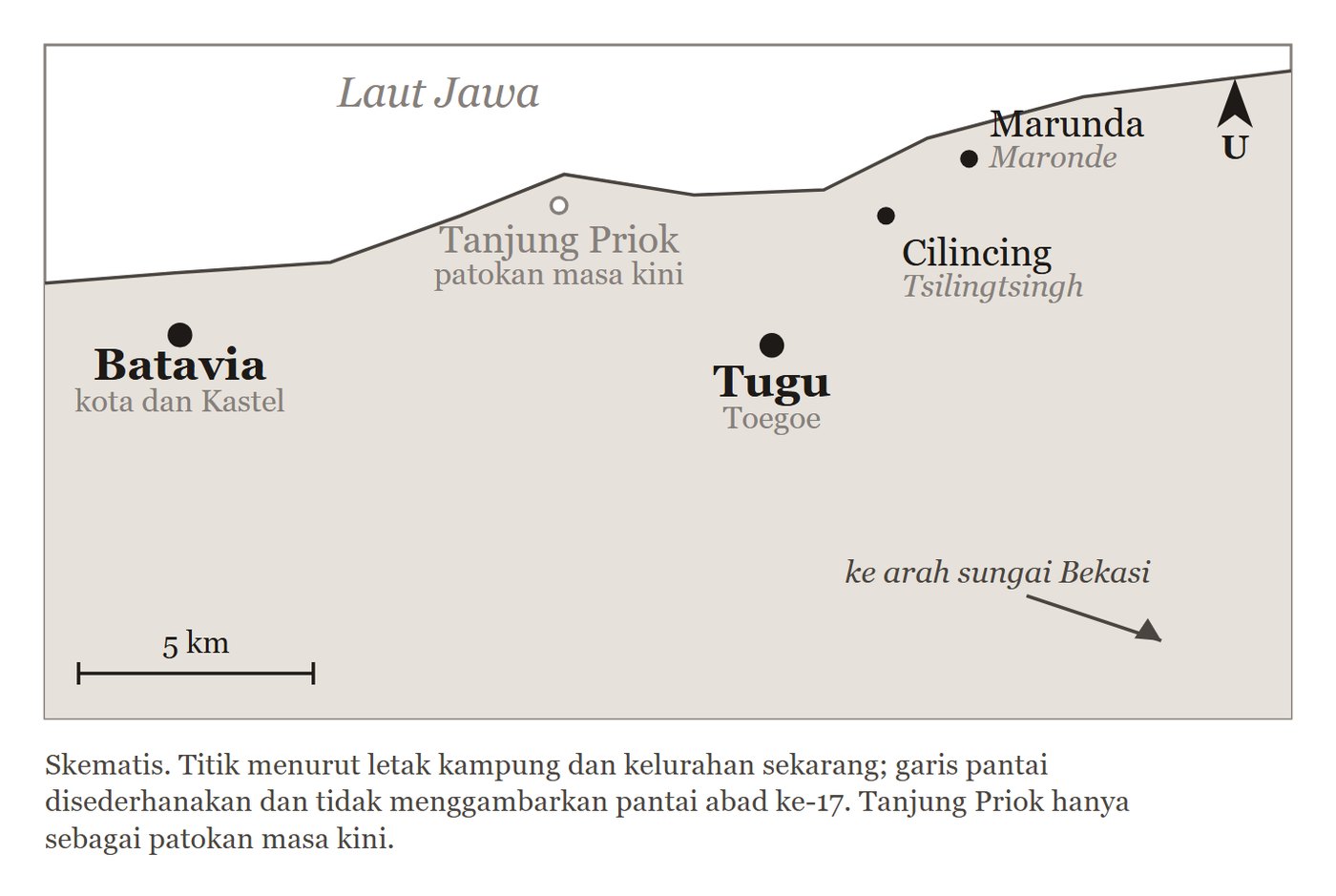
Illustration 2. Batavia and the coast to its east. A schematic map made for this book: points follow the position of present-day kampungs and urban villages, the coastline is simplified, and Tanjung Priok is shown only as a present-day reference point.
Becoming “Portuguese”
In the nineteenth century the words shifted again. In 1843 a missionary named Hupe wrote from Batavia that the Christians at Tugu, about a hundred people, were Nachkommen der Portugiesen, descendants of the Portuguese, “the former masters of the land”, with enslaved Bugis women.19 Among the sources read for this book, that is the oldest writing to call the people of Tugu descendants of the Portuguese. The letter reaches us through a quotation by a linguist almost half a century later. The government itself still used other words. In 1872 J. Beukhof, zendeling-leeraar, mission minister, bij de inlandsche christen-gemeente te Depok en Toegoe, the native Christian congregation at Depok and Tugu, was given two years' sick leave.20 By then inlandsch was commonly used for the population of the Indies, and the Tugu congregation was served together with the Depok congregation by a single mission minister.
Around 1890 Hugo Schuchardt published a text from Tugu that called the language of its inhabitants “the language of the Portuguese”, while its speaker admitted not knowing how they had come to live in Tugu.21 A few years later, in September 1897, a resident of Depok named C. de Graaf wrote a letter to the editor calling the Tugu congregation a gemeente van afstammelingen van Portugeezen, a congregation of descendants of the Portuguese, which had once flourished but now numbered only about 120 souls.22 Two years after that a newspaper in Medan, summarizing A. G. Vorderman's conjecture about the song Nina Bobo, wrote something different: een soort van Portugeesch, a kind of Portuguese, was spoken at Toegoe by the descendants of enslaved people from the end of the eighteenth century.23 In October 1911 a Batavia newspaper wrote that the Portuguese had settled at Toegoe before the Dutch arrived, Christianized the inhabitants, and mixed with them, until there arose een geheel bizonder volkje, a quite distinctive little people.24
Seven years later, in 1918, A. Th. Manusama called Portuguese descent de algemeene meening, the general opinion, and then rejected it (Chapter 4).25 In 1932 a writer using the pen name Si Omong explained that general opinion another way: native Christians in Batavia had once also been called Portugeezen, and that was why the people of Toegoe were sometimes thought to be descendants of the Portuguese.26 In 1946 the Dutch army's communiqué called the inhabitants of Toegoe descendants of een oude Portugeesche nederzetting, an old Portuguese settlement.27
The anthropologist Raan-Hann Tan notes two things that help in reading this shift. First, the historians Ulbe Bosma and Remco Raben, according to Tan, regard the Mardijker group as largely a creation of the administration, whose boundaries could differ from everyday reality. Second, local people called the Mardijkers “Portuguese” or “black Portuguese”, probably because they spoke a Portuguese Creole, and for local people anyone who was Christian and spoke Portuguese was Portuguese.28 If that picture is right, “Portuguese” may already in the VOC period have been a name given from outside, one that pointed to religion and language. In the twentieth century the name was read as origin.
The words in this book
For that reason this book uses names with care. Mardijker is kept as a historical term, set in italics, and read as a changing social and legal category, not as a nation. The word inlandsch in seventeenth- and eighteenth-century sources is left as it stands, because its meaning at that time was not the same as “native” in the nineteenth century. The word “Portuguese” is explained wherever it is used: language, congregation, government category, or claim of origin. The people who lived in Tugu are named according to the source: Christian households, congregation, landowners, Mardijkers, where the source uses that word.
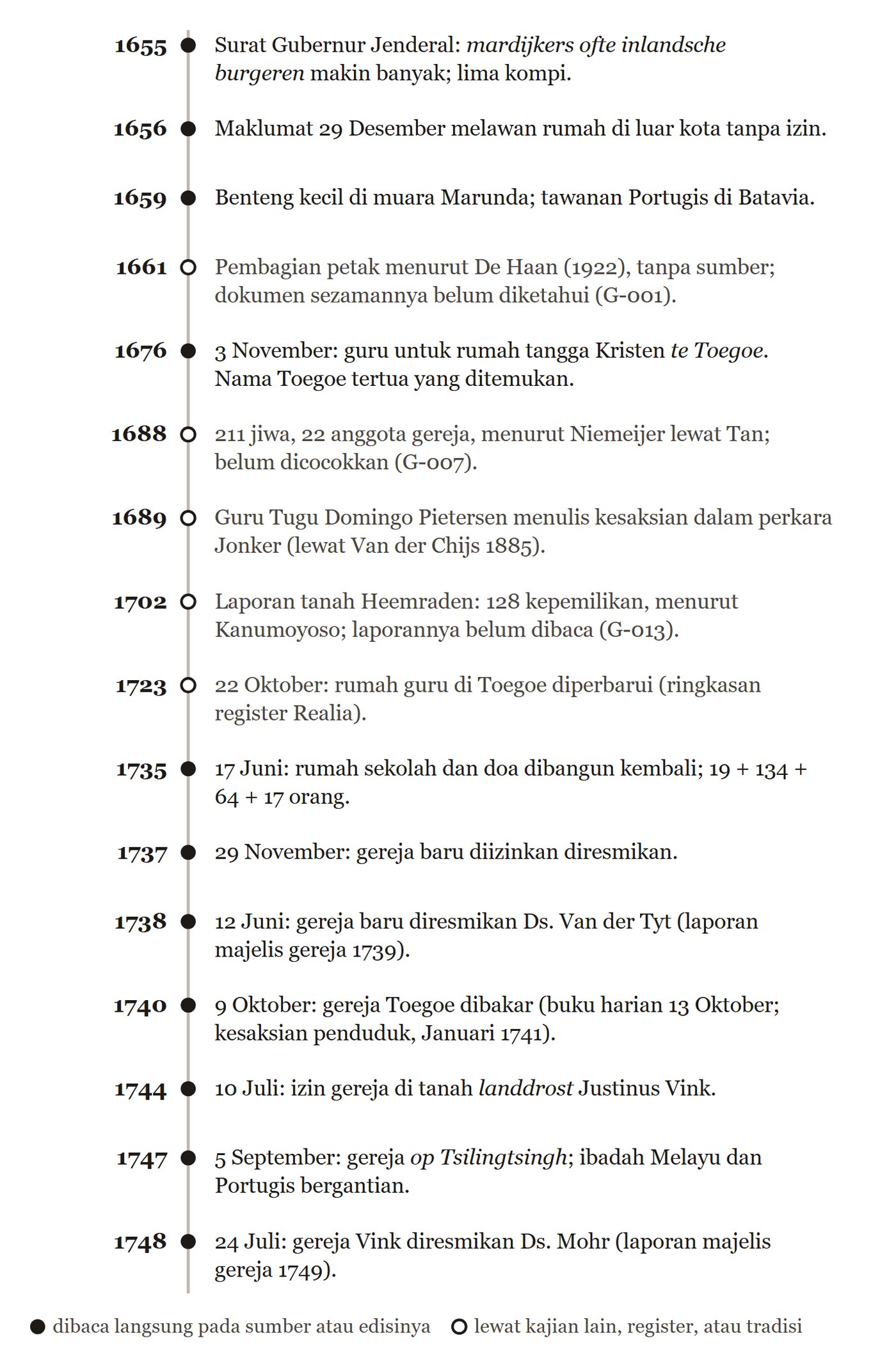
Illustration 3. Tugu in the sources read for this book, 1655–1748. The 1661 entry is De Haan's statement (1922); its contemporary document is not yet known. Black dot: read directly in the source or its edition; open dot: through other studies, a register, or tradition. Made for this book.
What is not yet known
When the word “Portuguese” was first used for Tugu as a name of origin is not yet known. In the seventeenth- and eighteenth-century documents read so far for this book, the word refers only to language and congregation. The oldest writing found so far that uses “Portuguese” as origin is the missionary Hupe's letter of 1843, which reaches us through Schuchardt's quotation. Among the fifteen press clippings from 1864–1932 that have been read, the oldest is the letter to the editor of 1897. The original publication of Hupe's letter, the contents of Beukhof's book of 1890, and writings before 1843 have not yet been read (G-021). The description of the Mardijkers by Cornelis Chastelein, the landowner of Depok, in his writing of 1705 has not been quoted for this edition. The stories about the origins of the people of Tugu, including the tale of a shipwreck and of Portuguese prisoners from Malacca, are discussed in Chapter 2 and Chapter 4 (G-003).
Notes
-
W. Ph. Coolhaas, ed., Generale missiven van gouverneurs-generaal en raden aan Heren XVII der Verenigde Oostindische Compagnie, deel II: 1639–1655 (’s-Gravenhage: Martinus Nijhoff, 1964), 807, missive of 26 January 1655; author's translation. The ellipsis inside the quotation is Coolhaas's editorial ellipsis. The volume's year of publication has not been checked on the title page. ↩
-
Raan-Hann Tan, “Por-Tugu-Ese? The Protestant Tugu Community of Jakarta, Indonesia” (doctoral thesis, ISCTE–Instituto Universitário de Lisboa, 2016), 41, following Jean Gelman Taylor, The Social World of Batavia: European and Eurasian in Dutch Asia, 2nd ed. (Madison: University of Wisconsin Press, 2009), 47. Kanumoyoso cites the same etymology from Taylor. Taylor has not been read directly for this book. ↩
-
F. de Haan, Oud Batavia (Batavia: G. Kolff & Co., 1922), I:452, § 832. De Haan writes “basterd-Portugeesch”. On p. 453 (the wording has not been checked against the original printing) he acknowledges that the only figure for slave imports comes from the eighteenth century. ↩
-
Tan, “Por-Tugu-Ese?”, 41. This is Tan's summary of the literature, not the result of her own archival research. ↩
-
De Haan, Oud Batavia, I:519, § 960. In § 873 (I:472) De Haan gives the year 1635 for the same division into four companies; the discrepancy is De Haan's own and has not been checked against his source. ↩
-
Realia. Register op de generale resolutiën van het Kasteel Batavia, 1632–1805 (1882–1886), entry of 8 June 1641 (subject Commissarissen van Huwelijkse Zaaken; Placcaten, Edicten enz.): “dat de officieren der burgerije geen Mardijkers mogen eligeren, dan die redelijk Nederduyts spreken”. Register; the text of the resolution has not been read (G-017). ↩
-
Dagh-Register gehouden int Casteel Batavia [...] Anno 1656–1657, ed. J. de Hullu (’s-Gravenhage: Martinus Nijhoff, 1904), 22, summary for November 1656. The original manuscript has not been seen. ↩
-
Dagh-Register [...] Anno 1659, ed. J. A. van der Chijs (Batavia: Landsdrukkerij; ’s-Hage: M. Nijhoff, 1889), 262, summary for the year 1659. The sum of the burial categories in the edition does not match the printed total (943 against 929); the figures for each category are quoted as they stand. ↩
-
Coolhaas, Generale missiven II, 807 (see the opening of this chapter); Tan, “Por-Tugu-Ese?”, 46, note 44, citing Hendrik E. Niemeijer, Batavia: Masyarakat Kolonial Abad XVII (2012), 36. Niemeijer has not been read directly. ↩
-
Realia, entry of 9 April 1668 (subject Begraafplaats): “’t Ambons quartier, benoorden d’Amanus gragt, tot een begraafplaats der buyten Mardijkers te approprieeren”. Register; the text of the resolution has not been read. ↩
-
Tan, “Por-Tugu-Ese?”, 43, citing Lance Castles, “The Ethnic Profile of Djakarta”, Indonesia 3 (1967): 157. Castles has not been read directly. ↩
-
Realia, entry of 26 May 1761 (subject Inlandse Militairen; Militaire Zaaken): “De Mardijkers worden afgedankt”. Register; the scope of the disbandment (all companies or some) is not known from the text of the resolution. Tan, “Por-Tugu-Ese?”, 46–47, notes the VOC regulation of 1781 on freed enslaved people who embraced Christianity as Mardijkers, and Mardijker companies “on a decline already in 1797”; their relation to the 1761 entry has not been examined. ↩
-
Van der Chijs, Nederlandsch-Indisch Plakaatboek II (1886), 579. Both phrases come from the item heading and the editor's summary sentence; the text of the 1676 decision is not printed and has not been seen. ↩
-
ANRI, Arsip Gouverneur-Generaal en Raden van Indië (Hoge Regering), inv. 974, resolution of 17 June 1735, fol. 730–731. ↩
-
ANRI, Hoge Regering, inv. 1000, resolution of 10 July 1744, fol. 396. ↩
-
Realia, entry of 10 July 1744 (subject Toegoe, Bataviase Ommelanden, Kerkelijke Zaaken). All three entries use inlandsche or inlandse gemeente; the text of the resolution reads “ten dienste van de Christen Gemeente”. The Realia was published in 1882–1886; the ANRI archive inventory mentions contemporary indexes and repertories compiled by the VOC, and the old term realia, so the entry may have been compiled much earlier than its year of publication. ↩
-
ANRI, Hoge Regering, inv. 980, resolution of 29 November 1737, fol. 1398; inv. 1003, resolution of 5 September 1747, fol. 556. See Chapters 9 and 10. ↩
-
Tan, “Por-Tugu-Ese?”, 44, note 43, quoting Taylor, The Social World of Batavia (2009), 48, who gives the wording of the inscription in English translation: “In honor of the new Church for the Portuguese or Native community [...]”. Tan calls it “a 1695 inscription on a silver plate in the church”, that is, the Portuguese church that is now Gereja Sion. The original wording has not been seen. ↩
-
Hugo Schuchardt, “Kreolische Studien IX. Ueber das Malaioportugiesische von Batavia und Tugu”, Sitzungsberichte der philosophisch-historischen Classe der kaiserlichen Akademie der Wissenschaften (Wien) 122, Abh. 12 (1890), 21–22. Schuchardt quotes Hupe's letter from Batavia, 1843, published in Neuere Geschichte der Evangelischen Missions-Anstalten zur Bekehrung der Heiden in Ostindien, ed. Hermann Agathon Niemeyer, Stück 90 (Halle, 1844), Vorrede, XI; that publication has not been seen. Text: “Die nicht so zahlreichen und nicht so guten Christen (etwa 100) in Tugu sind Nachkommen der Portugiesen, der frühern Herren des Landes, mit bughinesischen Sclavinnen.” The claim of descent is the letter writer's opinion, with no source given. Author's translation. ↩
-
“Civiel Departement”, Bataviaasch Handelsblad, 14 February 1872, 3; Delpher. ↩
-
Tan, “Por-Tugu-Ese?”, 42, quoting the English translation in Philippe Maurer, The Former Portuguese Creole of Batavia and Tugu (Indonesia) (London/Colombo: Battlebridge, 2011), 151. See the Prologue. Year of publication of the Vienna edition: 1890 according to the Graz copy, 1891 according to some bibliographies. The Tugu material reached Schuchardt between August 1884 and February 1888 (Chapter 4, Chapter 11). ↩
-
C. de Graaf, “Een protest”, Java-Bode, 21 September 1897, bijvoegsel; Delpher; letter dated Depok, 18 September 1897. Text: “De eens aldaar gevestigde, bloeiende gemeente van afstammelingen van Portugeezen is door koortsen, pokken en cholera en verhuizing naar Batavia tot op een 120tal zielen geslonken”. The letter is a polemic against Swaving's writing on Depok; Tugu is mentioned only in that paragraph, and the figure has no source. For an older writing, Hupe's letter of 1843: note 19. Author's translation. ↩
-
“Gemengd Nieuws. Nina bòbò”, De Sumatra post (Medan), 20 December 1899; Delpher. Text: “hoe thans nog te Toegoe, nabij Tandjoeng Priok door de afstammelingen van slaven uit dien tijd, een soort van Portugeesch gesproken wordt”; “dien tijd” refers to “het laatste der vorige eeuw”, the end of the eighteenth century. The newspaper summarizes Vorderman in the Notulen of the Bataviaasch Genootschap, which have not been read. Author's translation. ↩
-
“Een vergeten plekje”, Het nieuws van den dag voor Nederlandsch-Indië, 23 October 1911; Delpher. The author is not named, and the article gives no source for the story (see Chapter 4). For the oldest writing that uses “Portuguese” as origin, see note 19. Author's translation. ↩
-
A. Th. Manusama, “Muziek. Krontjong. (Vervolg)”, Bataviaasch nieuwsblad, 27 July 1918; Delpher. ↩
-
Si Omong, “De Mardijkers in het oude Batavia”, Algemeen Handelsblad (Amsterdam), 12 December 1932, evening edition, 5; Delpher. Text: “Het merkwaardige is dat Inlandsche christenen destijds ook ‘Portugeezen’ werden genoemd, wat verklaart waarom wel eens wordt gemeend dat de kleine groep inheemsche christenen, thans nog in geisoleerd milieu levende te Toegoe, beoosten Tandjong Priok, afstammelingen zijn van de Portugeezen.” Si Omong also writes that the Mardijkers were descendants of Asian and African people freed from slavery, not descendants of the Portuguese. The article gives no source; its racial language is the language of 1932, and the seventeenth-century claims in it are not used in this book. Author's translation. ↩
-
“Tijdige actie. Inheemsche Christenen in veiligheid”, Het Dagblad (Batavia), 18 January 1946, 2; Delpher. ↩
-
Tan, “Por-Tugu-Ese?”, 43, citing Ulbe Bosma and Remco Raben, Being “Dutch” in the Indies: A History of Creolisation and Empire, 1500–1920 (Singapore: NUS Press, 2008), 53, for the administrative category, and Andaya and Andaya (2012), 227, for the division into “white Portuguese” and “black Portuguese”. The sentence about what local people called them is Tan's own, with no separate reference. These sources have not been read directly. ↩