Stone, Name, and Song
Before you read: quotations from the archives keep their original spelling, and a translation follows. The codes G-001 and so on mark questions that are still open; they are listed in the Register of Gaps. The rules for names, spelling, and footnotes are explained in the Note to the Reader, at the back of the book.
On a Monday afternoon in mid-January 1946, a woman from the kampung of Tugu came to the local military command. She asked that the Christian congregation of her kampung be evacuated. Two days later some ten army trucks set out from Priok to Tugu, and by about three in the afternoon the evacuees had been housed in empty houses in the kampung of Pejambon, behind the Willemskerk. That day's journey is told in the Epilogue.1
At the end of its report, the communiqué of the Dutch army's information service added one sentence about who the newly evacuated people were. Toegoe, it wrote, was a Christian congregation more than two hundred years old, nakomelingen van een oude Portugeesche nederzetting, descendants of an old Portuguese settlement.2 Four days after the communiqué appeared, a newspaper in Nijmegen printed a letter from a woman born in Toegoe. She called the kampung of her birth “oorspronkelijk een Portugeesche nederzetting”, originally a Portuguese settlement. The kroncong music that was also known in the Netherlands, she wrote, came from Toegoe, “waarschijnlijk van Portugeesche origine”, probably of Portuguese origin.3
By the middle of the twentieth century, then, the name Tugu was already attached to the word “Portuguese”. This book asks how that name took shape, and what was written about the people of Tugu long before it existed.
Name
On 3 November 1676, according to the editor's summary in a collection of government edicts, the government in Batavia appointed an inlandsch leermeester, a teacher, for Tugu. Those who had asked for him “earnestly” were 40 to 50 Christian households living there.4 In 1735 a government resolution spoke of de gemeente op Toegoe, the congregation at Tugu, and recorded its members by category: 234 people in all, most of them already baptized.5 In 1744 an official asked permission to build a church on the bank of the Tugu river ten dienste van de Christen Gemeente, for the Christian congregation living there and in two places nearby.6
In all three documents the inhabitants of Tugu are Christians, and their origins are not mentioned. The oldest documents about Tugu do not call its inhabitants Portuguese.
The word “Portuguese” does appear in eighteenth-century documents, but as the name of a language and of a congregation. In 1737 the person permitted to dedicate the new church at Tugu was the minister in de portugese gemeente, the Portuguese congregation in the city.7 On 5 September 1747 the government decided that in the church newly built for that congregation, worship was to be held “so wel in de maleytse als Portugeese tale”, in the Malay as well as the Portuguese language.8 Portuguese was present in Tugu, alongside Malay. That its inhabitants were descended from the Portuguese is not stated.
The distance between 1747 and 1946 is the distance between a language of worship and an origin. Chapter 1 traces how the words used for the people of Tugu changed across that distance.
Song
The language survived long enough to be recorded by linguists. Around 1890 the linguist Hugo Schuchardt published a text from Tugu. In the English translation quoted by the anthropologist Raan-Hann Tan, the speaker says, more or less: you gentlemen wish to know our language and how we came to live in Tugu; the second we do not know, but our language we know well, the language of the Portuguese.9 According to that text, the people of Tugu at the end of the nineteenth century called their language Portuguese, but did not know how they had come to Tugu.
The letter from Nijmegen in 1946 adds song. Its writer relates that her father, an Ambonese teacher, was posted to Tugu by the mission society around 1890. There he trained the congregation in singing and the flute, until it had a flute orchestra that accompanied the church singing.10 Kroncong, which is now Tugu's mark of identity, is discussed in the Epilogue, as part of the history of memory.
Stone
The author visited the Tugu Church on 9 May 2026, with a tour group visiting the old churches of Jakarta. The building that stands today has white walls and a tiled roof, with a porch in front of its door. In its yard a bell hangs between two posts. Inside there is a polygonal pulpit and canopied council pews. Behind the church lies a cemetery which, according to Evi Quiko, a descendant of Tugu, is reserved for the descendants of Tugu people and for outsiders who married them; its gravestones have not been read for this edition (G-030).11
The 1946 communiqué says that the church at Tugu resembled in many respects the old Portuguese church in the lower city of Batavia, and was built on the same model.12 Whether that building is the church for which permission was given to an official in 1744, and which in 1747 was said to stand at Tsilingtsingh, cannot yet be confirmed (G-020). The history of Tugu's church buildings up to 1748 is discussed in Chapters 7, 9, and 10.
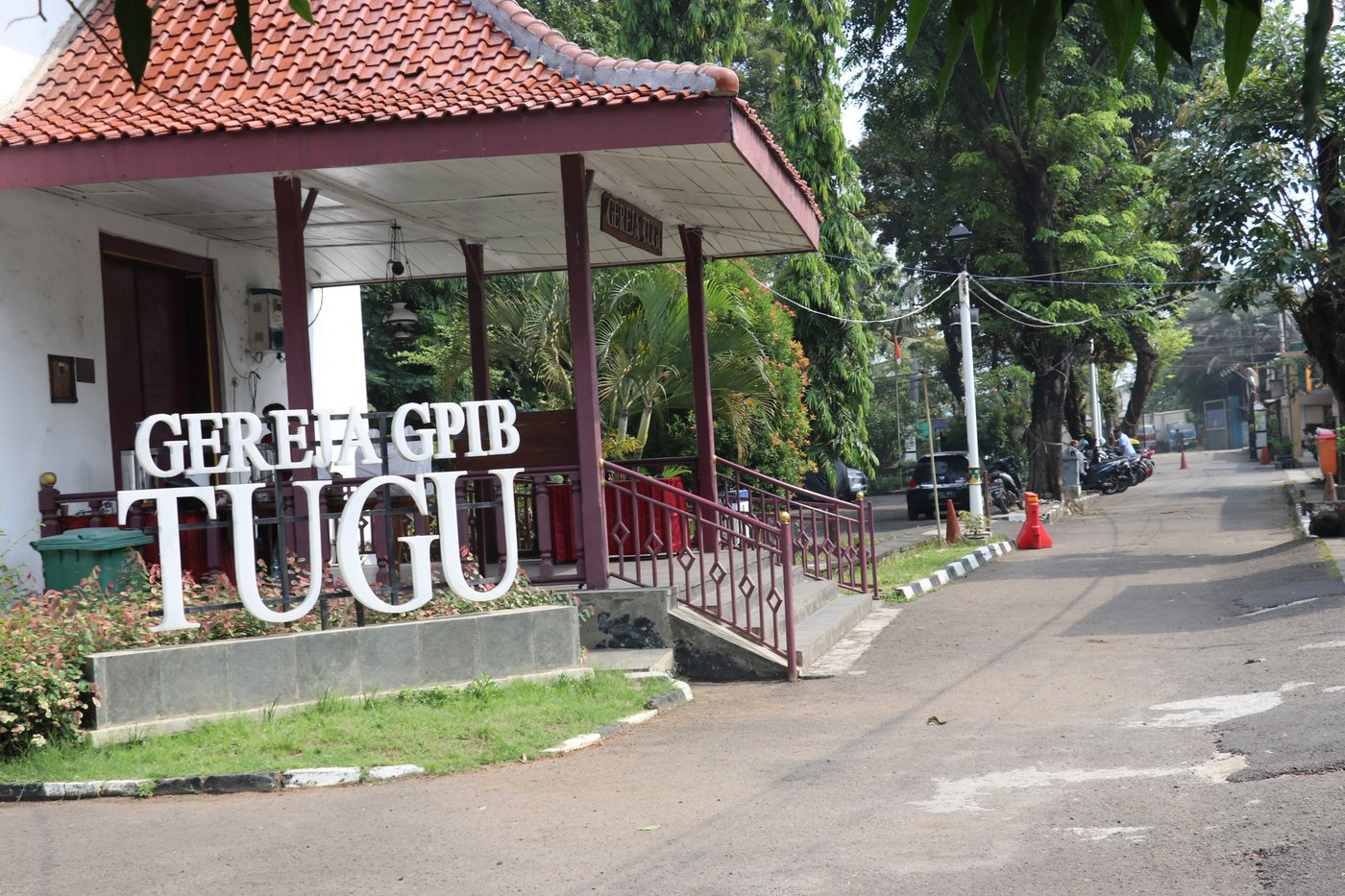
Illustration 1. The Tugu Church seen from the porch, May 2026. Whether this building is the church for which permission was given to Justinus Vink in 1744 has not been confirmed from the archives (G-020). Photo: Nasau Tour, 9 May 2026.
What this book is looking for
This book follows the Christian community at Tugu through contemporary documents. The story begins when free Asian Christians, called Mardijker in the archives, became a group that was counted and armed in Batavia after 1641. It ends with the church built by Justinus Vink, which in 1747 was said to stand at Tsilingtsingh, nearly finished. The sources are chiefly the government archives of the VOC: resolutions of the Governor-General and Council of the Indies, the day journal of Batavia Castle, edicts, and official letters to the Netherlands. The minutes of the Batavia church council for most of that period have not been read for this edition.13
The limits of 1641 and 1748 are working limits. The year 1641, when Malacca fell to the VOC, is used as the beginning because after it the Mardijker group in Batavia is recorded as growing and being regulated (Chapter 2); the VOC sources on the fall of Malacca itself have not been read for this edition (G-031). The year 1748 is used as the end because on 24 July of that year Vink's church, whose dedication had been permitted in September 1747, was dedicated (Chapter 10). The year 1641 is a limit for the question, not a claim that the fall of Malacca has been shown to be directly connected with Tugu.
From these documents emerges a picture more varied than a single Portuguese settlement. There are Christian households asking for a teacher, and a congregation counting its communicant members. There are landowners who, according to a list quoted by Niemeijer and Kanumoyoso, bore Portuguese or Dutch names, or the names of places of origin in India. There is a church whose worship was held in two languages. Whether that picture holds for the period 1641–1748, and where the first people at Tugu came from, cannot yet be answered with certainty. Those questions are left open, with G codes in each chapter.
This book does not set out to decide who the people of Tugu are today. The way the descendants of Tugu remember their origins, including their ties with Portugal, is discussed in the Epilogue as living memory, not as an error to be corrected. The inquiry begins with the most basic thing: the words the sources used for the people of Tugu. Chapter 1 begins with a letter of 1655 that calls them by two names, mardijkers and inlandsche burgeren.
Notes
-
“Tijdige actie. Inheemsche Christenen in veiligheid”, Het Dagblad (Batavia), 18 January 1946, 2, communiqué of the Voorlichtingsdienst van het Koninklijk Nederlandsch-Indische Leger; Delpher. “Monday afternoon” follows Maandagmiddag j.l. in the communiqué; the date is not given. The communiqué also gives the reason for the evacuation request according to the woman; that reason and the events of January 1946 are discussed in the Epilogue, with the caution that the source is the voice of the Dutch military. ↩
-
Het Dagblad, 18 January 1946, 2; author's translation. ↩
-
L. van de Wetering-Tomasouw, “De evacuatie van kampong Toegoe. Een van de oudste Christendorpen op Java”, Nijmeegsch Dagblad, 22 January 1946, 2; Delpher. Author's translation. ↩
-
J. A. van der Chijs, ed., Nederlandsch-Indisch Plakaatboek, 1602–1811, deel II (1886), 579, item of 3 November 1676; author's translation. The edition prints only the item's heading and a one-sentence summary; the text of the original decision has not been seen. ↩
-
ANRI, Arsip Gouverneur-Generaal en Raden van Indië (Hoge Regering), inv. 974, resolution of 17 June 1735, fol. 730–731. The total of 234 was calculated by the author from the four categories named in the resolution. See Chapters 7 and 9. ↩
-
ANRI, Hoge Regering, inv. 1000, resolution of 10 July 1744, fol. 396. The two places are Groote Maronde and Tjilingtsingh. See Chapter 10. ↩
-
ANRI, Hoge Regering, inv. 980, resolution of 29 November 1737, fol. 1398. See Chapter 9. ↩
-
ANRI, Hoge Regering, inv. 1003, resolution of 5 September 1747, fol. 556; author's translation. See Chapter 10. ↩
-
Raan-Hann Tan, “Por-Tugu-Ese? The Protestant Tugu Community of Jakarta, Indonesia” (doctoral thesis, ISCTE–Instituto Universitário de Lisboa, 2016), 42, quoting the English translation in Philippe Maurer, The Former Portuguese Creole of Batavia and Tugu (Indonesia) (London/Colombo: Battlebridge, 2011), 151. The text comes from Hugo Schuchardt, “Kreolische Studien IX. Über das Malaioportugiesische von Batavia und Tugu”, Sitzungsberichte der Kaiserlichen Akademie der Wissenschaften in Wien, Philosophisch-Historische Klasse 122 (1891), according to Tan's bibliography. Schuchardt's introduction, pp. 1–3 and 20–22, and the essay Tampat perdiaman kami dan orang-orangnja (pp. 42–44) are quoted from Schuchardt's own publication. He received the Tugu material through correspondence in 1884–1888. Other excerpts from the Creole text are quoted through Maurer's translation as quoted by Tan; the original text and Maurer's full translation have not been compared. The Vienna edition is dated 1890 according to the Graz copy, 1891 according to some bibliographies; the difference concerns the dating of the edition, not the time of collection. The author's rendering of this text was made from that English translation and is left as a paraphrase. Tan writes “collected by the linguist Schuchardt in 1891”. ↩
-
Van de Wetering-Tomasouw, “De evacuatie van kampong Toegoe”, 2. This is family testimony written 56 years after the fact; the year “omstreeks 1890” comes from the letter's writer. ↩
-
The author's observation, Saturday 9 May 2026, during a visit by the Jakarta Heritage Church Tour group to several old churches in Jakarta; photo: Nasau Tour. The age of the building, pulpit, pews, and bell was not examined for this book; the inscriptions in the church are discussed in the Epilogue. Information on the cemetery: the author's interview with Evi Quiko, 9 May 2026 (see the Epilogue). ↩
-
Het Dagblad, 18 January 1946, 2: “Er staat in Toegoe een kerkje dat in vele opzichten gelijkt op de Oude Portugeesche kerk in de beneden-stad. Zij is volgens hetzelfde model gebouwd.” ↩
-
Archief van de Kerkeraad van de Nederduits Gereformeerde Gemeente te Batavia, according to Archives of the Dutch East India Company (VOC) and the Local Institutions in Batavia (Jakarta) (Leiden: Brill; Jakarta: ANRI, 2007), 531. The minutes for 1729–1740, 1740–1744, and 1744–1749 (inv. 7–10) have not been read for this book. ↩